Views: 0 Author: Site Editor Publish Time: 2026-09-10 Origin: Site
What are pimple patches made of? Most classic hydrocolloid pimple patches combine an absorbent hydrocolloid adhesive or matrix with a thin protective backing, plus a release liner or carrier that is removed before application.
The exact polymers, adhesive system, backing material, thickness, and optional skincare ingredients vary by product. That is why it is more accurate to think in terms of functional components than to assume every pimple patch follows one fixed three-layer recipe.
A pimple patch looks like a simple sticker, but its performance depends on several material choices working together. The familiar hydrocolloid pimple patch combines a moisture-responsive material with an adhesive structure and a protective outer surface so the patch can stay over a localized spot while interacting with moisture at the skin surface.
The important detail is that these functions are not always separated into three perfectly distinct physical layers. In some hydrocolloid constructions, the absorbent particles and pressure-sensitive adhesive are part of the same composite matrix. Other products use different laminates, films, carriers, or added ingredients. So when someone asks what is in a pimple patch, the most useful answer is to look at what each component is designed to do.
The backing is part of the patch that remains on your skin. The release liner is temporary packaging material that protects the adhesive surface and is removed before use. Product diagrams sometimes make these look like the same “top film,” which causes unnecessary confusion.
Hydrocolloid is not one ingredient. It describes a family of water-responsive polymer materials capable of swelling or forming a gel when they interact with moisture. Hydrocolloid dressings have long used this material behavior for fluid management, and pimple patches adapt the same basic concept to a much smaller spot-care format.
In a plain pimple patch, the hydrocolloid portion interacts with moisture available at the surface of a blemish. As the material hydrates, it can swell and become cloudy or white. That visible change reflects hydration of the material; it should not be interpreted as proof that a patch has “pulled toxins” or material from deep beneath the skin.
| Material family | Why it may appear in hydrocolloid technology | Important limitation |
|---|---|---|
| Carboxymethylcellulose (CMC) | A hydrophilic cellulose derivative widely used in hydrocolloid dressing technology because it can take up water and contribute to gel formation. | Its presence and amount are product-specific. |
| Pectin | A polysaccharide used in some hydrocolloid systems as part of the gel-forming material. | Not every pimple patch contains pectin. |
| Gelatin | A protein-based hydrocolloid found in some traditional dressing compositions. | Its use cannot be assumed from the word “hydrocolloid.” |
| Other hydrophilic polymers | Different manufacturers can use alternative or modified polymer systems to reach the desired absorbency and wear properties. | The approved material specification is the reliable source for a specific SKU. |
That last point matters for both shoppers and private-label brands. Two products can both be described as hydrocolloid acne patches while using different material compositions, thicknesses, adhesive systems, or manufacturing structures.
The outer surface helps give the patch mechanical support and protects the hydrocolloid structure during wear. Depending on the design, hydrocolloid dressing technologies can use thin polymer films or other flexible backing materials.
The backing helps the patch retain its shape, resist handling damage, and remain easier to position over a small target area.
Thickness, transparency, surface gloss, edge profile, color, and decorative printing can all affect how noticeable a patch looks on skin.
Polyurethane film is common in medical dressing technology, and other polymer films can also be used depending on the design. For a specific pimple patch, however, the exact backing polymer should come from its technical specification rather than be guessed from appearance.
This is where the common “three separate layers” explanation becomes misleading. In some hydrocolloid technologies, the hydrophilic particles are dispersed within a hydrophobic pressure-sensitive adhesive matrix. The same working layer therefore provides both moisture interaction and adhesion.
Traditional hydrocolloid dressing technologies have used adhesive components such as polyisobutylene and elastomeric systems, while newer materials can use different chemistries. A consumer pimple patch should not be assumed to contain PIB, SIS, or any other specific adhesive unless the supplier or product specification confirms it.
That removable sheet is generally a release liner or carrier, not the protective backing that stays on your face. Its job is to protect the adhesive surface during manufacturing, packaging, storage, and handling, then release the patch cleanly when you are ready to apply it.
The liner material and release treatment are manufacturing and packaging choices. They can affect how easily the consumer lifts a small patch without folding or stretching it, which becomes especially important for thin patches and small diameters.
Hydrocolloid is the defining material story for a plain patch. Additional skincare or acne-treatment ingredients are optional and should be evaluated separately rather than treated as part of the universal hydrocolloid recipe.
| Product direction | What may be added | What brands need to remember |
|---|---|---|
| Plain hydrocolloid | No additional skincare active is required for the basic moisture-responsive patch format. | Communicate the physical material function accurately without turning it into an unsupported acne-treatment claim. |
| Cosmetic ingredient story | A project may incorporate or market ingredients such as botanical extracts or other cosmetic ingredients when technically appropriate. | The ingredient, delivery format, substantiation, and cosmetic claims all need to match the finished product. |
| U.S. acne-drug positioning | An OTC acne active such as salicylic acid may be used under the applicable U.S. drug framework. | Acne-treatment claims and drug actives change the regulatory and labeling requirements of the finished product. |
| Dissolving microstructure patch | Micro-cones can be made from soluble polymer or ingredient matrices. | This is a different patch architecture and should not be described as simply another layer of a flat hydrocolloid patch. |
For the U.S. market, salicylic acid can function as an OTC acne-drug active when the finished product is marketed for acne treatment under the applicable requirements. Formula, claims, directions, warnings, and label format need to be developed together.
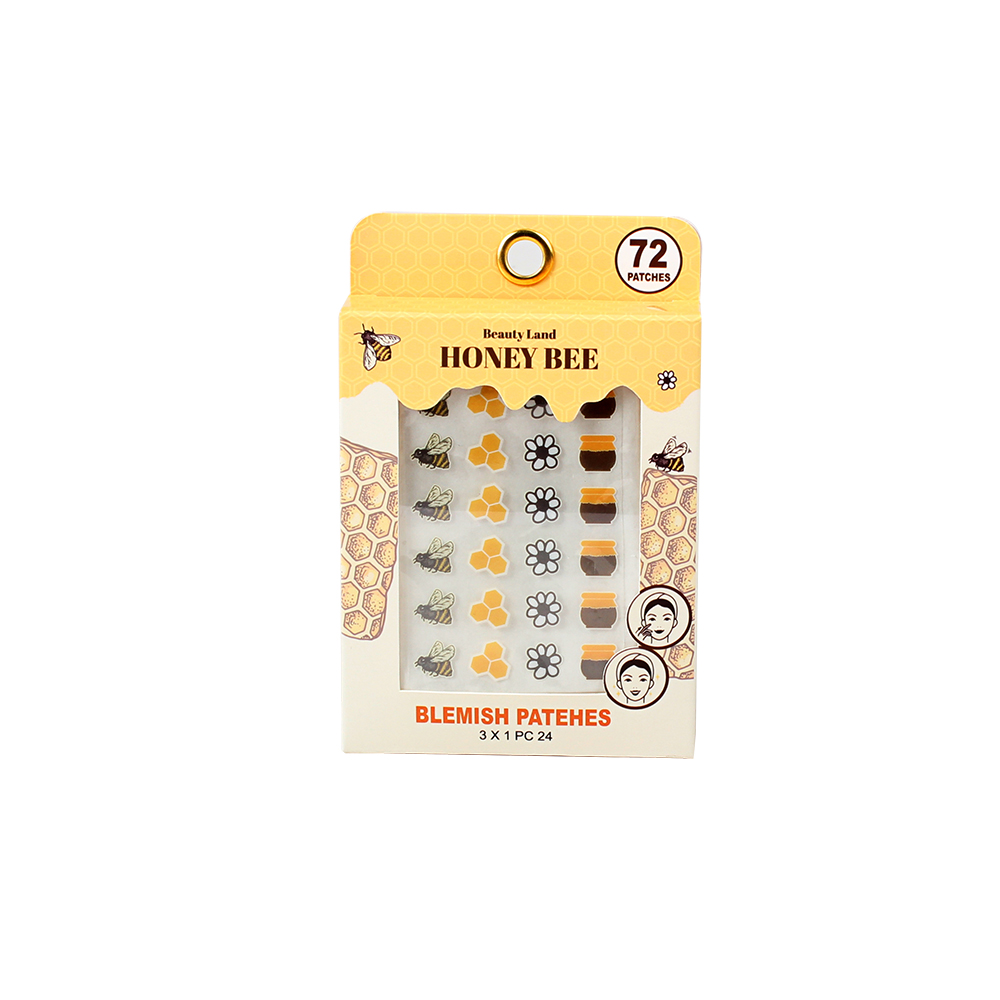
Our current BL25019-HB provides a useful first-party example of how material concept, ingredient story, patch count, and retail packaging can come together in one SKU. The current product page identifies both Hydrocolloid Technology and Natural Honey Extract.
Not always. The ingredient declaration can tell you a great deal about ingredients intentionally added to the finished consumer product, but the complete structural construction of a patch can also involve backing, liner, adhesive, processing materials, and component specifications that are easier to identify in a technical data sheet or approved manufacturing specification.
At BeautyShirley, we treat a pimple patch as a complete product system rather than choosing “hydrocolloid” and stopping there. The intended use and consumer experience need to be translated into material construction, patch dimensions, adhesion, visual finish, ingredient story, sheet layout, packaging, directions, and claims.
Brands can explore our current pimple patch range or use our OEM/ODM customization service to develop a patch concept around the intended market, format, packaging, and claim strategy.
No. Hydrocolloid describes the moisture-responsive working material in a classic patch, but the finished product also needs a structural and adhesive system. Depending on the design, it can include a protective backing, a hydrocolloid adhesive matrix, a removable release liner, and optional ingredients or decorative components.
Hydrocolloid technologies can use hydrophilic polymers such as carboxymethylcellulose, pectin, gelatin, or other gel-forming materials. The exact composition varies, so those examples should not be treated as the ingredient list for every pimple patch.
No. Some designs can have clearly distinguishable layers, while other hydrocolloid technologies combine hydrophilic absorbent material with a pressure-sensitive adhesive matrix. The exact construction depends on the product.
It is generally a release liner or carrier that protects the skin-contact side during storage. It is removed before application and should not be confused with the backing layer that remains on the worn patch.
No. Plain hydrocolloid patches do not require salicylic acid. If salicylic acid is used as an acne-treatment active in a U.S. product, the finished patch and its claims need to follow the applicable OTC acne-drug requirements.
Yes. BeautyShirley's current public product page identifies natural honey extract and hydrocolloid technology for BL25019-HB. The listing does not provide the complete polymer or adhesive specification, so we do not infer those details from the consumer page.
Not necessarily. Dissolving microstructure patches use a different working architecture with small soluble projections rather than relying only on a flat hydrocolloid sheet. Their materials and intended delivery system need to be evaluated separately.
Define the patch architecture, dimensions, absorbency target, adhesion, thickness, appearance, optional ingredients, sheet layout, packaging, intended use, and claims. At BeautyShirley, we align those variables as one development brief rather than treating hydrocolloid as the entire specification.
What are pimple patches made of? For a classic hydrocolloid format, the answer is usually some combination of a moisture-responsive hydrocolloid adhesive or matrix, a protective backing, and a removable liner used before application. But the precise construction and polymer chemistry vary from product to product.
That is why terms such as CMC, pectin, gelatin, polyurethane, polyisobutylene, or SIS should be treated as material examples—not as a universal ingredient list for every acne patch. Optional skincare ingredients and acne-treatment actives add another layer of product-specific decisions.
For brands, the material question becomes a specification question: define what the patch needs to absorb, how it should wear, how visible it should be, what ingredients and claims belong in the concept, and how the sheet and package should support the finished product. That is how we approach custom pimple patch development at BeautyShirley.