
Views: 0 Author: Site Editor Publish Time: 2026-09-16 Origin: Site
Most body lotions are built as emulsions that combine a water phase with an oil or emollient phase, then use emulsifiers, rheology modifiers, humectants, preservation, and other supporting ingredients to create a stable leave-on moisturizer.
There is no universal body lotion recipe. Two lotions can use the same ingredient families and still feel completely different because the emollients, humectant system, emulsifier structure, viscosity, fragrance, preservation strategy, packaging, and finished specifications have been designed differently.
A body lotion may look simple when it comes out of a pump, but the finished product depends on several ingredient systems working together. Understanding body lotion ingredients is therefore less about memorizing a list of popular oils or actives and more about understanding what each functional group contributes to the formula.
Water provides a continuous phase in many lotion formats. Humectants help support water retention in the outer skin layer. Emollients change softness, slip, and after-feel. Emulsifiers help keep oil and water phases physically organized. Rheology modifiers control flow and viscosity. A suitable preservation strategy helps manage microbiological risk. Fragrance, botanical extracts, vitamins, and other ingredients can then be added around the intended product brief.
The ingredient families above are common, but their presence, selection, and relative amounts are product-specific. A lightweight pump lotion, a richer body lotion, and a fragrance-free lotion can all use the same broad architecture while requiring very different specifications.
Water and oils do not form a stable lotion simply by being stirred together. In an emulsion, one liquid phase is dispersed as small droplets within another phase, while the emulsifier system and overall structure help maintain that dispersion during storage and use.
Oil-in-water emulsions, where oil droplets are dispersed through a continuous water phase, are common in body lotion because they can support fluid, easy-spreading textures. Water-in-oil emulsions are another possible architecture and can produce different sensory and barrier properties. Neither emulsion type is defined solely by whether the front label says “lotion,” “cream,” or “body butter.”
Frequently used for fluid or lightweight lotions, but the final richness still depends on the emollient system, rheology, and other formula variables.
Can create a different sensory and occlusive profile, but it should not automatically be equated with every rich cream or body butter.
Water is commonly the predominant ingredient in many conventional body lotions and acts as a solvent and carrier for water-soluble components. The water phase may also contain humectants, salts, water-soluble polymers, botanical ingredients, vitamins, or other materials that are compatible with the formulation.
Typical water-compatible ingredients can include glycerin, propanediol, butylene glycol, panthenol, sodium PCA, urea, beta-glucan, or selected extracts. Their presence does not tell you the finished performance by itself—the complete formulation and amount used matter.
Humectants are ingredients with an affinity for water. In a body lotion, they can help increase and retain water in the stratum corneum—the outermost layer of the skin—while also affecting formula feel.
| Ingredient example | Typical formulation role | What not to assume |
|---|---|---|
| Glycerin | Widely used humectant that helps support skin hydration and affects slip and tack. | The presence of glycerin alone does not tell you how hydrating the complete lotion will be. |
| Panthenol | Can contribute humectant and skin-conditioning functions depending on the formula. | Its finished-product benefit depends on concentration and formulation context. |
| Sodium PCA | Water-binding ingredient used in moisturizing systems. | It is not required for a lotion to be considered moisturizing. |
| Urea | Can provide humectant and other concentration-dependent functions. | Its role cannot be inferred without knowing the specific finished formula. |
The oil or emollient side of a lotion is responsible for much of its sensory personality. Formulators can select plant oils, hydrocarbons, esters, silicones, butters, waxes, or other cosmetic emollients to change glide, cushion, richness, residue, and softness.
Examples can include squalane, triglycerides, esters, plant oils, mineral oil, silicones, and butters. Each brings a different combination of slip, spread, cushion, and residue.
Some oils, waxes, hydrocarbons, silicones, and butters can contribute a more persistent surface film that helps reduce water loss from the skin.
These functions overlap. An ingredient does not need to fit neatly into only one textbook category, and the same named ingredient can feel very different depending on the rest of the formula.
A lotion needs more than water and oil. Its structural system determines whether the emulsion remains physically stable, whether the texture suits the selected package, and how the lotion changes as it is rubbed across the skin.
Viscosity is not merely a cosmetic detail. It has to work with filling, pumping or squeezing, storage, consumer handling, and the desired sensory profile. That is why formula architecture and package compatibility are developed together.
| Function | What it contributes | Ingredient examples |
|---|---|---|
| Humectant | Helps increase or retain water in the outer skin layer. | Glycerin, sodium PCA, panthenol, urea, selected glycols. |
| Emollient | Improves softness, lubrication, spread, and skin feel. | Squalane, esters, triglycerides, plant oils, silicones, butters. |
| Occlusive | Helps reduce water loss by creating a more persistent surface film. | Petrolatum, mineral oil, selected silicones, waxes, butters. |
Microbiological safety is a fundamental part of developing a water-containing cosmetic. Water, raw materials, processing conditions, packaging, storage, and consumer handling can all influence the risk of microbial contamination.
Many conventional lotions therefore use a preservative system. Common cosmetic preservatives can include phenoxyethanol, parabens, organic-acid salts, benzyl alcohol, or other permitted systems depending on the formula and target market. The correct choice depends on factors such as pH, water activity, ingredient compatibility, packaging, and the required microbiological performance.
A formula can use different approaches to microbiological control, but every finished product still needs to be evaluated for safety under its intended manufacturing, packaging, storage, and use conditions. An anhydrous product is not automatically exempt from microbiological risk simply because no water was intentionally added.
For brands, the practical question is not “Can we remove the preservative?” but “What preservation strategy keeps this specific finished formula safe and stable throughout its intended use?”
Once the base lotion architecture is established, additional ingredients can support a particular consumer experience or cosmetic positioning. These ingredients are not automatically required for a lotion to function as a moisturizer.
A lotion can be fragranced, lightly fragranced, or designed without added fragrance depending on the market brief.
Their value depends on the actual extract, level, stability, formulation compatibility, and claims supported for the finished product.
These ingredients can be incorporated when technically appropriate, but their presence alone does not establish a particular efficacy claim.
Ingredient origin and ingredient function are different questions. Plant-derived ingredients can be excellent formulation choices, and synthetic ingredients can also provide useful safety, stability, sensory, or performance functions.
“Chemical-free” is not a scientifically meaningful description of a lotion because every physical ingredient—including water—is made of chemicals. More useful questions are whether the ingredients are appropriate for the intended use, whether the formula is stable and microbiologically controlled, and whether the claims accurately reflect the finished product.
A professional lotion formula is developed as a process as well as an ingredient list. Water-compatible materials and oil-compatible materials may be prepared separately, the emulsion is formed under controlled mixing conditions, and temperature-sensitive ingredients are incorporated according to the requirements of the specific raw materials.
The exact temperature, mixing method, addition order, homogenization conditions, and acceptance ranges are formula-specific. They should come from the validated manufacturing process rather than from a generic lotion recipe.
For cosmetics sold at retail in the U.S., ingredient declarations generally list ingredients in descending order of predominance, subject to applicable labeling requirements. That makes the ingredient list useful for understanding the formula, but it is not the same thing as a manufacturing specification.
Water is often prominent in conventional lotions. Look for the major humectants, emollients, and structuring ingredients around it.
Ask what an ingredient does in the formula rather than labeling individual ingredients “good” or “bad.”
An ingredient declaration cannot tell you the precise percentage, process, emulsion structure, stability system, or sensory performance.
An ingredient list is useful for identifying ingredients you want or need to avoid, but comparing two lotions solely by list position can miss important differences in formulation architecture.
A moisturizing lotion can combine several mechanisms. Humectants help support water content in the stratum corneum. Emollients improve softness and smoothness. More occlusive ingredients can help reduce water loss. The finished sensory profile determines whether those effects feel lightweight, silky, rich, waxy, dry-touch, or cushiony.
Claims such as “24-hour hydration,” “long-lasting moisture,” or other quantified performance statements should come from appropriate substantiation for the finished product. They cannot be reliably predicted from seeing one ingredient—or even one functional group—on the label.
Our BLCO26005 Daily Hydration Body Lotion shows how several familiar ingredient functions can come together in a finished body-care concept. The formula features Glycerin, Squalane, and Oat Beta-Glucan, while the finished lotion is presented in a 300 ml bottle with a colored pump.
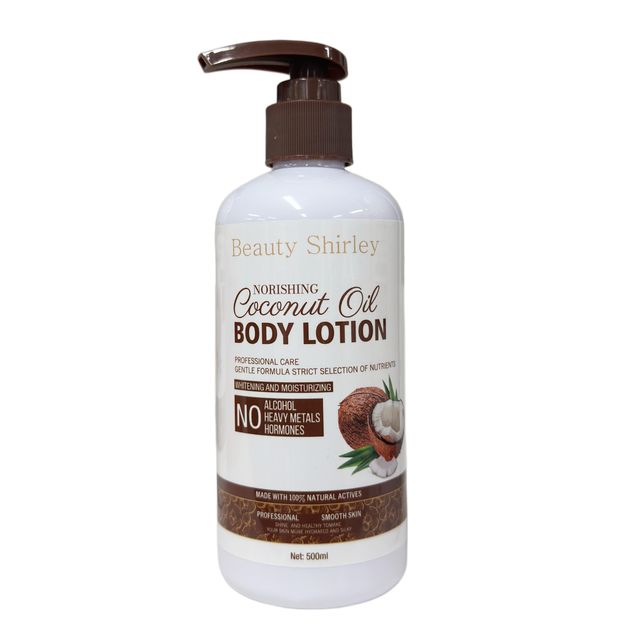
Glycerin provides a clear humectant example, while squalane contributes emollient properties and oat beta-glucan adds another ingredient dimension. The complete lotion also depends on its emulsion, rheology, preservation, fragrance, and packaging systems working together.
At BeautyShirley, we approach body lotion development by defining the intended consumer experience first. A request such as “add shea butter, niacinamide, and aloe” is not yet a complete formulation brief. We also define the target texture, spread, after-feel, fragrance direction, packaging, market, and cosmetic positioning before the ingredient architecture is finalized.
Explore our Body Lotion & Body Butter range for body-care format ideas, or use our OEM/ODM customization service to develop a body lotion around your formula, fragrance, packaging, and brand brief.
Many body lotions combine water, humectants, emollients, emulsifiers, rheology modifiers, and a suitable preservation system. Fragrance, botanical extracts, antioxidants, vitamins, chelators, pH adjusters, and other ingredients can be added depending on the specific formula.
Water is commonly the predominant ingredient in many conventional oil-in-water body lotions, but that is not a universal definition. Different emulsion architectures and richer formats can use a different phase balance.
Moisturizing performance can come from several ingredient functions working together. Humectants help support water content in the outer skin layer, emollients improve softness and smoothness, and occlusive ingredients can help reduce water loss.
In an emulsion lotion, the emulsifier system helps stabilize the interface between the oil and water phases. It works together with the overall formula structure rather than acting as a single “glue” ingredient.
Water-containing lotions normally require an effective strategy for controlling microbial growth, and that often includes conventional cosmetic preservatives. The exact preservation approach depends on the complete formula, packaging, manufacturing process, water activity, pH, and intended use.
Parabens are one established class of cosmetic preservatives. Ingredient safety should be evaluated by the specific ingredient, exposure, permitted use, and finished formulation rather than by assuming that “paraben-free” automatically means safer.
Niacinamide can be used as an additional skin-conditioning ingredient in a lotion concept. The benefit and claim supported by a specific product depend on the actual concentration, formula, testing, and intended cosmetic positioning.
Not precisely. Ingredient order gives useful information about predominance under applicable labeling rules, but it does not disclose exact percentages. It also does not reveal the manufacturing process, emulsion structure, raw-material specifications, or stability system.
Not necessarily. Body butter is a broad market category and can include anhydrous formulas as well as emulsified products. It should not be defined by one fixed oil-to-water ratio.
Start with the desired texture, after-feel, target user experience, fragrance, packaging, market, and claims. Then select the humectant, emollient, emulsion, rheology, preservation, and optional ingredient systems around that brief. At BeautyShirley, we develop those elements as one finished-product system.
Body lotion ingredients make more sense when you read them as a system instead of a list of hero ingredients. Water, humectants, emollients, emulsifiers, rheology modifiers, preservation, and optional ingredients each solve a different formulation problem.
The presence of glycerin, shea butter, squalane, niacinamide, aloe, or another familiar ingredient cannot tell you by itself whether a lotion will be light, rich, stable, moisturizing for a particular duration, or appropriate for every skin type. Those outcomes belong to the complete finished formula.
For brands, the best lotion brief therefore begins with the desired consumer experience and product requirements, then builds the ingredient architecture around them. That is how we approach custom body lotion development at BeautyShirley.


