Views: 0 Author: Site Editor Publish Time: 2026-09-09 Origin: Site
Sugar scrub vs salt scrub is mainly a comparison between two water-soluble physical exfoliants—but the ingredient name alone does not tell you which finished scrub will feel gentler or stronger.
Sugar and salt can both be produced in different particle sizes and grades. The actual exfoliating experience depends on crystal size and shape, particle load, the oil or emulsion base, how quickly the particles dissolve during use, application pressure, and the condition of the skin. Sugar scrubs are often positioned as softer-feeling body exfoliants, while salt scrubs are often positioned for a more noticeable polishing experience, but those are formulation tendencies—not fixed rules.
Both sugar scrubs and salt scrubs are forms of mechanical exfoliation. Their particles create controlled friction at the skin surface as the product is massaged over the body and rinsed away.
The easy version of the comparison says “sugar is gentle and salt is strong.” The more accurate answer is that particle engineering matters more than the ingredient name alone. A finely graded salt scrub can feel very different from one made with large salt crystals, just as a coarse sugar scrub can feel considerably more abrasive than a finely graded one.
| Comparison point | Sugar scrub | Salt scrub |
|---|---|---|
| Primary abrasive | Usually sucrose or another sugar-based crystal. | Usually sodium chloride or another salt-based crystal. |
| Typical market positioning | Often positioned around a softer-feeling, spa-style body polish. | Often positioned around a more noticeable or mineral-inspired body polish. |
| Particle size | Can be fine, medium, or coarse depending on the selected grade. | Can also be fine, medium, or coarse depending on the selected grade. |
| Particle shape | Varies with crystal grade and processing; do not assume every sugar crystal is perfectly rounded. | Varies with crystal grade and processing; salt is not automatically coarse or sharply edged. |
| Dissolution during use | Water-soluble; dissolution depends on particle size, water exposure, temperature, and formulation. | Also water-soluble; dissolution depends on the same product and use variables. |
| Potential sting on compromised skin | Mechanical friction can irritate damaged or recently shaved skin. | Mechanical friction plus dissolved salt can feel particularly uncomfortable on damaged skin. |
| What determines intensity | Particle grade, load, base, pressure, contact time, and skin condition. | Particle grade, load, base, pressure, contact time, and skin condition. |
A coarse sugar scrub can create more friction than a finely graded salt scrub. The finished product—not the ingredient headline—is what determines the real exfoliating experience.
A physical body scrub uses particles and hand movement to mechanically loosen and remove some dead cells from the outermost skin surface. The immediate result can be a smoother-feeling surface and a more polished appearance.
That is a surface-level cosmetic effect. A scrub does not “detox” the body, open pores, treat acne, cure keratosis pilaris, or need to leave the skin red in order to work. More pressure is not automatically better exfoliation.
Size, shape, hardness, concentration, and dissolution all influence how much friction the scrub creates.
Oil, emulsion, gel, surfactants, humectants, and emollients can make the same abrasive feel very different in use.
Pressure, massage time, frequency, water temperature, and the condition of the skin can matter as much as the particle itself.
“Sugar” and “salt” describe the abrasive material, but they do not specify its grade. A manufacturer can source smaller or larger particles and can control how much abrasive is suspended in the finished product. Those decisions have a direct effect on drag and perceived intensity.
This is also why a private-label specification should go beyond “make a sugar scrub.” The desired particle grade, load, texture, slip, rinse profile, and after-feel need to be defined together.
No reliable exfoliating benefit should be attributed to a sugar scrub simply because the formula contains sucrose. Sucrose and glycolic acid are different compounds. A standard sugar scrub should be evaluated as a physical exfoliant unless the finished formula separately contains an identified chemical exfoliant at an appropriate level.
The same principle applies to claims that salt automatically delivers meaningful magnesium, calcium, or other mineral benefits. The source of the salt can support a product story, but the mineral name alone does not establish how gentle, effective, or moisturizing the finished rinse-off scrub will be.
Sugar, sea salt, Himalayan salt, brown sugar, and similar descriptors can create different visual and marketing stories. Exfoliating intensity and skin feel still need to come from the complete formula and its particle specification.
A body scrub is not just a container of crystals. The abrasive sits inside a base that determines spreadability, cushion, rinse behavior, residue, fragrance delivery, and after-feel.
Can provide more slip and leave a more noticeable emollient film after rinsing.
Can combine cushion with a cleaner rinse, depending on the emulsifier and oil system.
Can create a lighter rinse profile and combine exfoliation with a more cleanser-like experience.
Because of that interaction, two scrubs using exactly the same sugar grade can feel completely different when one is suspended in a rich oil system and the other in a rinse-clean gel.
Start with the condition of your skin and the texture of the actual scrub rather than following a rule that assigns sugar to one skin type and salt to another.
| If you want... | What to compare | Better decision |
|---|---|---|
| A softer-feeling body polish | Fine particle grade, lower particle load, good slip, comfortable rinse profile. | A finely formulated sugar or salt scrub can potentially fit. |
| A more noticeable polish on intact rough body areas | Particle size, concentration, hardness, and pressure required during use. | Compare the actual product rather than choosing salt automatically. |
| A comfortable rinse-off feel | Oil/emollient system, surfactants, humectants, fragrance, and residue. | The base may matter as much as the abrasive. |
| A product for sensitive or easily irritated skin | Whether mechanical exfoliation is appropriate at all, plus particle grade and fragrance profile. | Do not assume sugar automatically makes a scrub suitable for sensitive skin. |
| Use on broken, sunburned, freshly shaved, or actively inflamed skin | The condition of the skin matters more than scrub type. | Skip physical scrubbing until the skin has recovered. |
Do not assume a sugar body scrub is automatically appropriate for the face, lips, or other delicate areas. Use a product on those areas only when the finished formula is specifically designed and labeled for that use.
With mechanical exfoliation, technique can change the experience dramatically. Gentle use is more important than trying to maximize friction.
Use lukewarm water and follow the product directions for whether the scrub is intended for wet or damp body skin.
Massage gently rather than pressing hard. More pressure increases friction and irritation risk.
A short, gentle massage is enough. Prolonged scrubbing is not required for a physical exfoliant to work.
Rinse thoroughly and reduce frequency or stop if the skin becomes persistently red, tight, tender, or irritated.
There is no evidence-based rule that every sugar scrub should be used two or three times per week while every salt scrub should be used once or twice. Follow the directions for the specific formula and adjust according to how your skin responds.
Our BL25022-HB Honey Gift Set is a useful first-party example because the same retail concept includes both a sugar scrub and a salt scrub. Instead of treating one abrasive as universally better, the set positions the two formats as different sensory options inside the same body-care story.
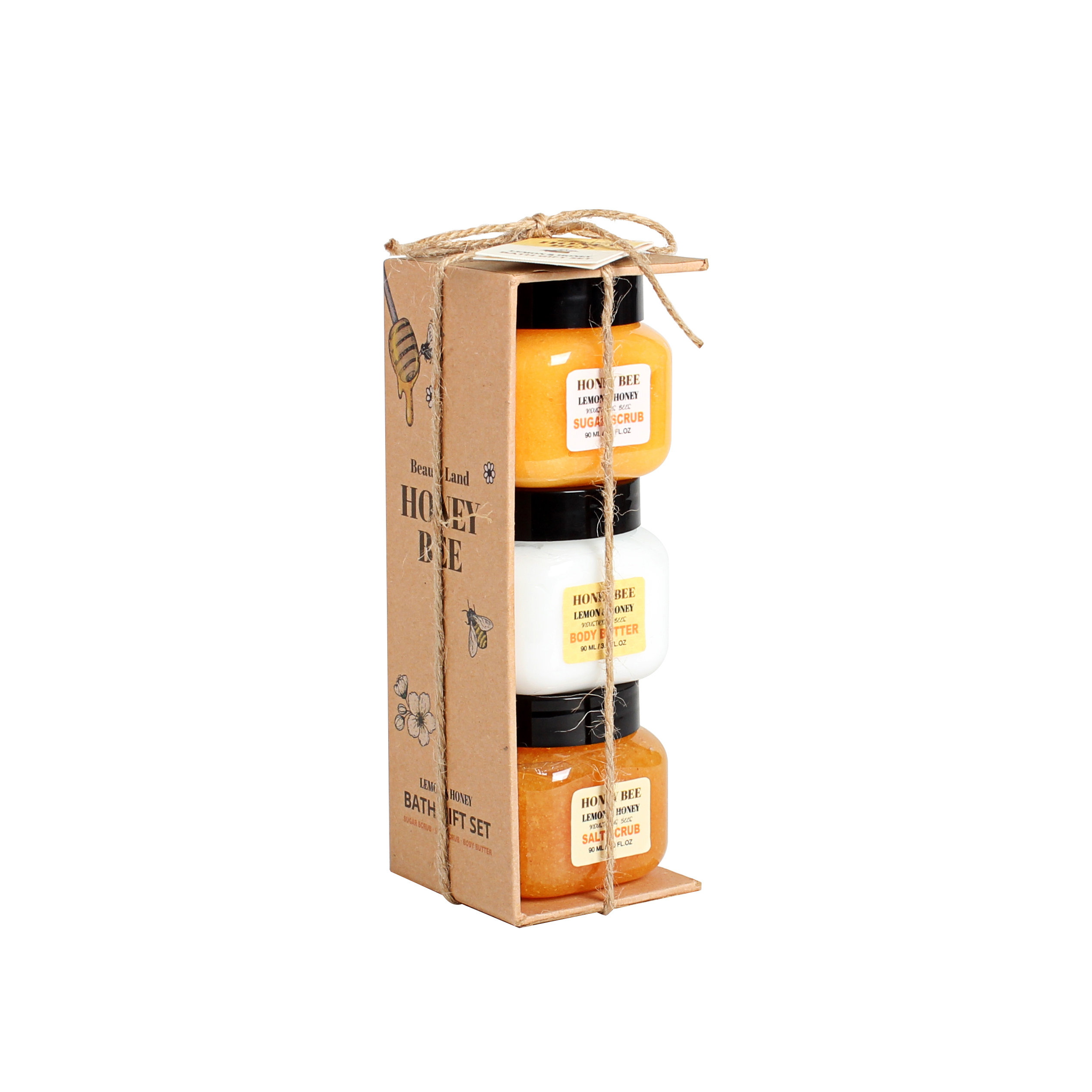
BL25022-HB makes the comparison concrete without claiming that one abrasive is objectively superior. For product development, sugar and salt can support different textures and positioning while still sharing one coordinated fragrance and packaging story.
At BeautyShirley, we approach body scrub development as a complete sensory system. Choosing sugar or salt establishes the abrasive family, but it does not finish the formula brief.
Brands can review current formats in our Scrubs & Exfoliants range or use our OEM/ODM customization service to develop the abrasive, base, fragrance, packaging, and branding around a specific body-care brief.
Not automatically. Sugar scrubs are often formulated for a softer-feeling polish, but actual gentleness depends on particle size, shape, concentration, base, application pressure, and skin condition. A coarse sugar scrub can be more abrasive than a finely formulated salt scrub.
Neither ingredient guarantees suitability for sensitive skin. Physical exfoliation itself can be irritating for some people. If your skin is reactive, choose a very gentle product designed for your skin needs, use light pressure, and reduce or stop exfoliation if irritation develops.
Do not assume a body scrub is suitable for facial skin simply because it uses sugar. Use a product on the face only when the finished formula is specifically designed and labeled for facial use.
Sugar itself should not be treated as a reliable glycolic-acid treatment. Sucrose and glycolic acid are different compounds. If a scrub is intended to provide AHA exfoliation, the finished formula should contain a separately identified acid system designed for that purpose.
Mineral origin can support a product's ingredient and sensory story, but it does not automatically make the scrub more effective or gentler. Physical exfoliation performance still depends on the crystal grade and complete formula.
There is no universal schedule based on whether the scrub contains sugar or salt. Follow the directions for the individual product and pay attention to your skin. If you develop persistent redness, tenderness, tightness, flaking, or stinging, reduce frequency or stop using the scrub until your skin feels comfortable again.
Avoid physically scrubbing broken, sunburned, freshly shaved, or actively inflamed skin. Mechanical friction can increase irritation, and a scrub is not an acne treatment.
The shelf life belongs to the complete finished formula, not the sugar or salt alone. Oils can oxidize, emulsions and water-containing products require appropriate preservation and stability, and packaging also affects product quality. Follow the expiration or period-after-opening information supplied with the specific product.
Start with the intended body-care experience, then define abrasive family, particle grade, particle load, base texture, rinse profile, fragrance, color, packaging, directions, and claims. At BeautyShirley, we develop those elements as one product system rather than treating “sugar” or “salt” as the entire brief.
Sugar scrub vs salt scrub is not simply “gentle versus strong.” Both are water-soluble physical exfoliants whose real performance depends on particle grade, concentration, formulation base, application technique, and the condition of the skin.
Sugar scrubs are often developed for a softer-feeling polish and salt scrubs are often positioned for a more noticeable exfoliating experience, but neither outcome is guaranteed by the ingredient name. Compare the finished product rather than relying on the abrasive headline alone.
For brands, that distinction becomes even more important: choosing sugar or salt is only the first specification. The particle grade, load, base, fragrance, rinse profile, package, directions, and claims are what turn the abrasive into a finished body scrub. That is how we approach scrub development at BeautyShirley.